


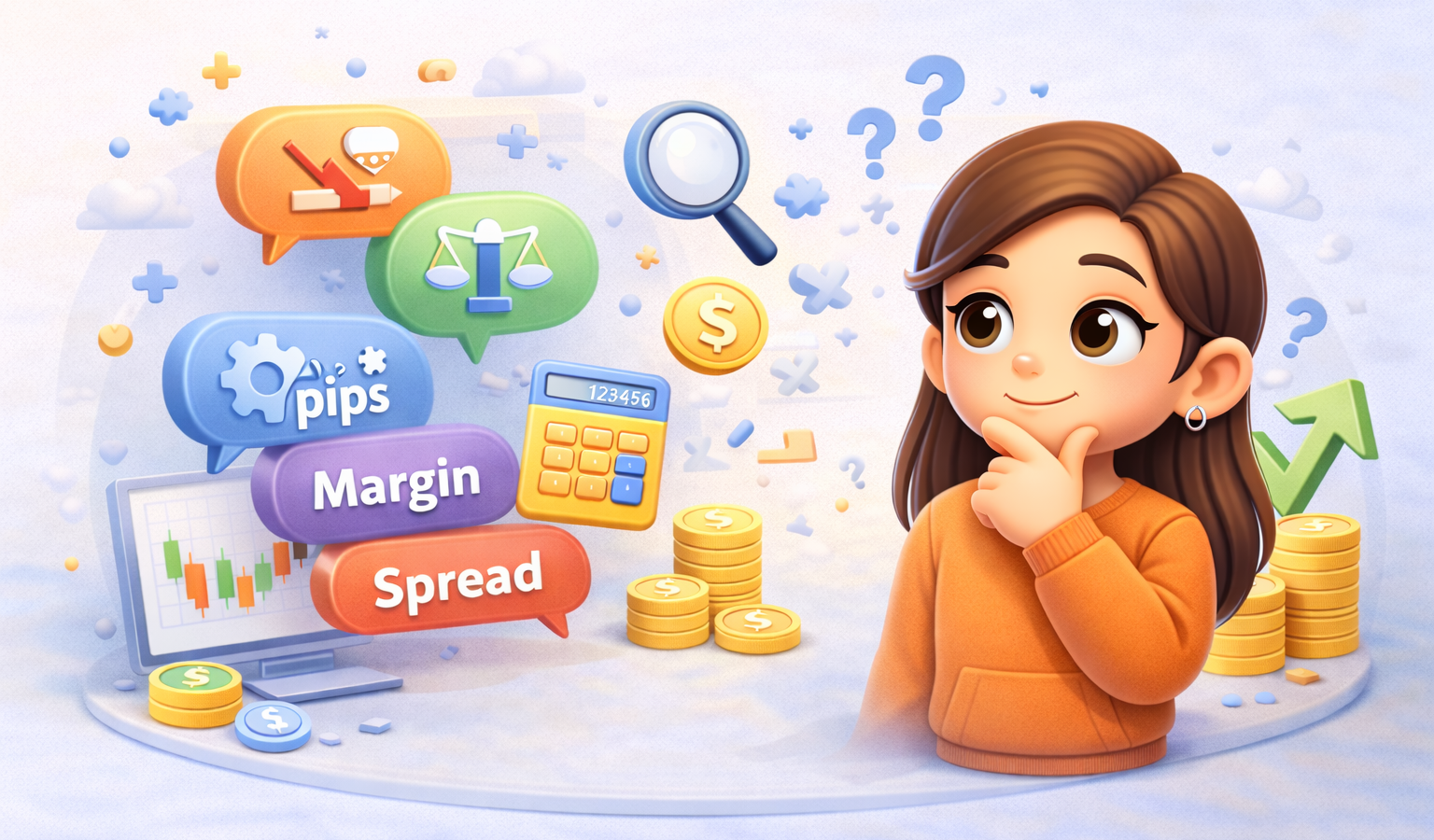
If you’re new to trading, one of the first challenges you’ll face is understanding the language.
Terms like pips, spread, leverage, and lot size can feel confusing at first.
But here’s the truth:
Once you understand the basic trading terms, everything else becomes much easier.
In this guide, we’ll break down the most common trading terms in a simple and beginner-friendly way.
Why Trading Terms Matter
Trading is not just about charts and buying or selling; it’s also about understanding the language used in the market.
When you understand trading terms, you can:
- follow tutorials more easily
- understand strategies better
- avoid costly mistakes
If you’re not yet familiar with how trading works, you can start with our guide “what is trading?“.
1. Pip
A pip is the smallest price movement in most forex pairs.
For example, if EUR/USD moves from 1.1000 to 1.1001, that is a movement of 1 pip.
Pips are used to measure how much the price has changed.
👉 Learn more in: Understanding Pips, Lots, and Leverage
2. Spread
The spread is the difference between the buy price and the sell price.
This is how brokers make money.
For example:
- Buy price: 1.1001
- Sell price: 1.1000
The difference (1 pip) is the spread.
3. Lot Size
Lot size refers to how much you are trading.
- Standard lot: 100,000 units
- Mini lot: 10,000 units
- Micro lot: 1,000 units
Bigger lot sizes mean higher risk and higher potential reward.
The above example doesn’t mean you can trade in any lot you like. It is flexible, which means you can type any amount in lots for your trade, whether 0.5 lot,1 lot, 2 lots, or whatever, depending on what you can
4. Leverage
Leverage allows you to control a larger position with a smaller amount of money.
For example, with $100, you could control $1,000 depending on your leverage.
Leverage increases both profit and loss, so it should be used carefully.
5. Margin
Margin is the amount of money required to open a trade.
It works together with leverage and acts as a deposit for your position.
6. Stop Loss
A stop loss is an order that automatically closes your trade at a loss to prevent further losses.
It is one of the most important risk management tools.
7. Take Profit
A take profit is an order that automatically closes your trade when it reaches a certain profit level.
8. Bullish and Bearish
- Bullish: expecting the price to go up
- Bearish: expecting the price to go down
These terms describe market direction. And there is “Range” which is used to describe market directions, of which price is neither bullish nor bearish.
9. Liquidity
Liquidity refers to how easily an asset can be bought or sold.
High liquidity means faster execution and smaller price changes. This simply tells you whether there is money in the market at the moment or not.
10. Volatility
Volatility measures how much the price moves.
High volatility means larger price swings, which can mean more risk and opportunity.
11. Broker
A broker is a company that allows you to access the market and place trades.
👉 Learn more: How Forex Brokers Work
12. Trading Platform
A trading platform is the software you use to analyze charts and place trades.
👉 Learn more: Trading Platforms Explained.
How to Learn Trading Terms Faster
The best way to learn trading terms is through practice.
- Use a demo account
- Read and apply what you learn
- Don’t try to memorize everything at once
👉 You can learn more about demo trading here: Demo vs Live Trading
Final Thoughts
Trading terms may seem overwhelming at first, but they are just tools to help you understand the market better.
Once you get familiar with them, you’ll find that everything becomes clearer and easier to follow.
Take your time, keep learning, and focus on understanding rather than memorizing.

1 Comment