

If you’ve started learning forex trading, you’ve probably come across terms like pips, lot size, and leverage.
I won’t say they sound confusing because they are confusing, but as time goes on, you’ll know like your name, that’s if you are serious
They are some of the most important concepts in forex trading, and once you understand them, everything starts to make a lot more sense.
In this guide, we’ll break them down in a simple way so you can actually understand how they affect your trades.
What Are Pips in Forex?
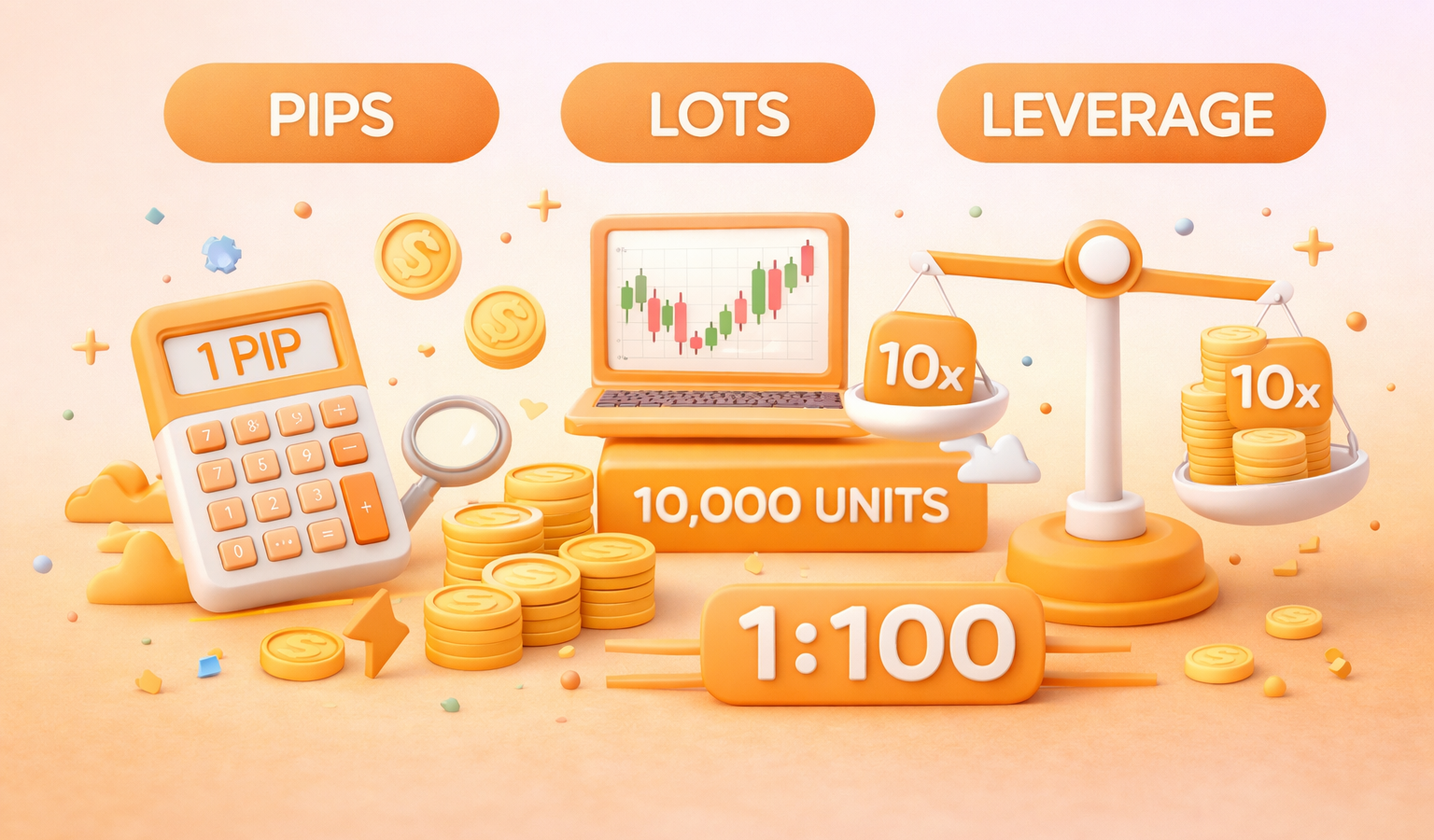
A pip is the smallest price movement in most forex pairs.
For example:
- If EUR/USD moves from 1.1000 → 1.1001, that is 1 pip
- If it moves from 1.1000 → 1.1010, that is 10 pips
Think of pips as a way to measure how much price has moved.
Instead of saying:
“Price moved a little”
You can say:
“Price moved 10 pips”
This makes everything clearer and more precise.
Why Pips Matter in Trading
Pips are important because they determine your profit and loss.
For example:
- If your trade gains 20 pips → you make money
- If your trade loses 20 pips → you lose money
But here’s the key thing:
How much money you make per pip depends on your lot size
What Is Lot Size in Forex?
A lot size refers to how much you are trading.
In forex, trades are not measured in “1 unit”; they are measured in lots.
Types of Lot Sizes
- Standard lot: 100,000 units
- Mini lot: 10,000 units
- Micro lot: 1,000 units
How Lot Size Affects Your Profit and Risk
The bigger your lot size:
- the more money you can make per pip
- but also the more money you can lose
For example:
- 1 pip with a small lot = small profit/loss
- 1 pip with a large lot = big profit/loss
So, lot size is directly connected to risk management and your profit.
What Is Leverage in Forex?
Leverage allows you to control a larger position with a smaller amount of money.
For example:
- With 1:10 leverage, $100 controls $1,000
- With 1:100 leverage, $100 controls $10,000
This is why forex is accessible even with small capital.
How Leverage Works (Simple Example)
Let’s say you have $100.
Without leverage:
- You can only trade $100
With leverage:
- You can trade much larger positions based on your ratio. so if your leverage is 1:10, this means you can trade with $100 even tho you only have $100. Your leverage largely depends on your broker and what you are trading in.
This increases your potential profit —
but also increases your potential loss.
Why Leverage Is Risky
Leverage is powerful, but it’s also dangerous if misused.
Many beginners:
- use high leverage
- open large positions
- and lose their accounts quickly
The key idea is simple:
Leverage amplifies both wins and losses
How Pips, Lot Size, and Leverage Work Together
These three concepts are connected.
- Pips → measure price movement
- Lot size → determines how much you gain or lose per pip
- Leverage → determines how large your position can be
Together, they define:
how much you risk
and how much you can gain or lose
Simple Example (Putting It All Together)
Let’s say:
- You enter a trade
- Price moves 10 pips
If:
- You use a small lot → small profit
- You use a large lot → bigger profit
If leverage is high:
- your position size increases
- and your risk(losses) increases as well
Common Beginner Mistakes
Many beginners struggle with these concepts at first.
Some common mistakes include:
- Using lot sizes that are too big.
- Relying too much on high leverage.
- Not understanding the pip value.
- Ignoring risk management.
These mistakes often lead to quick losses.
Final Thoughts
Pips, lot size, and leverage are not just technical terms,
They are the foundation of how forex trading works.
Once you understand them, you stop guessing and start thinking more clearly about your trades.
Take your time to understand these concepts properly.
They will play a big role in how you manage risk and grow as a trader.

3 Comments